Expatriate Experience of Life and Work in Nyasaland - by Colin Baker
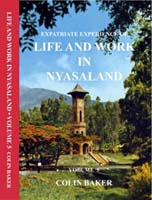
The following is an extract from "The Library"
Review by Anthony Young (Soil Surveyor, Nyasaland 1958-63)
When asked to review Volumes 5 and 6 of Colin Baker's magnum opus I suggested I might take on an overall review of the whole set of six volumes, a suggestion which was accepted. It proved to be a challenging but enjoyable task.
Let us begin with the two newly-published volumes. Readers of this journal will be familiar with the layout of the work: a series of contributions, mostly written on request, grouped under headings. Four new topics appear for the first time in Vol. 5 - Amateur Dramatics, Business and Trade, Gardening, and Needlework; and three further ones in Vol. 6 - Prisons, Reading and Literature,and, interestingly in this most recent one, "Why go to Nyasaland?"
These two volumes continue the collection of reminiscences found in the first four books, and I can recycle a few quotations from previous reviews of these. They contain unalloyed praise. "I see it as a unique and important historical record of what life was really like"; "For historians and anybody seeking the truth about life in those days it will be hugely valuable"; and, "How on earth did [Colin Baker] manage to persuade so many people...to write about their experiences?" (Jonathan Lawley, reviews of Vols. 1 and 3 respectively). With respect to the two new volumes, I cannot do more than echo these sentiments.
Now to the work as a whole. To appreciate what has been achieved one needs to start with some statistics. The six volumes total some 1920 pages, containing 640 contributions (as the author calls them) from about 450 different people. Colin himself contributes accounts, often more than one, to every volume. The individual accounts are grouped under 42 headings, ranging alphabetically from Administration (in all six volumes) to Women-Life and Work (four of them). As might be expected, the second most common heading is Families and Childhood, the 'Life' side of experiences. Naturally 'Travelling and Ulendo' (Safari) features prominently.
Colin writes that his account covers the 75 years of British service in the country, but a high proportion of the accounts cover 1930 to independence in 1964. Most contributors are British, but Greeks, Italians, South Africans and other nationalities add to the variety of experiences covered.
Supporting the text are photographs, numbering about 400, mostly in black and white, although a welcome innovation in Vol.6 is that some are in colour. These add greatly to the feel of the time and place: cars stuck on roads or in rivers, ladies smartly dressed (and men in uniforms) for occasions such as the King's/Queen's Birthday Parade. A few show early pioneers, and governors, and there are many of families.
Can one gain, from assembling all contributions, an overview of the achievements of different branches of the colonial service? No, and this is not the intention. There are some longer individual accounts which hint at this, for example a 9-page account of Geological Survey in Vol. 1, and the six on Nursing, two of over ten pages, in Vol. 3.
But contributors have rightly concentrated on what they think will interest readers, the exciting, bizarre, happy and occasionally sad events which they experienced. In my own contribution I devoted only one page to 'Work' (a soil survey of the country) and four times as much to why I went, the journey out and back, a brief secondment to the Police during the Emergency, and leisure - this last including an invitation to a pyjama party by one of the District Commissioners. Many accounts have a similar balance, others cover only a leisure activity - sport, fishing, hunting, amateur dramatics, the list is long. Notable is the story of the Mlanje Mountain Club (Vol. 1). The photographs are still more heavily orientated towards families, children and leisure.
In four volumes one finds the headings 'Government Officials'. This is curious first, because that covers all civil servants; and secondly, because under this heading are to be found additional items on Agriculture, Forestry and Police, and these are the only places to find Architecture, Audit and Survey.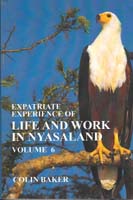
My main comment is about the absence of indexes. Most readers will wish to seek one of three types of item: articles by former friends, or on places they knew, on their own branch of work (education, customs service, police, military, etc.) or a type of interest such as natural history. It is a matter of regret that an index was not set up in the first volume and maintained subsequently in a cumulative manner. True, this robs readers of the fun of discovering what they seek for themselves, but to do so they would need to possess the full set of volumes.
So is this collection unique? Such a claim is based on Nyasaland being a relatively small country, with memories largely spanning a period of 35 years. An overall account was given by Frank Debenham in Nyasaland: the land of the lake (1955), but with an emphasis on the land and its local people, and only a chapter. The Bwana DCs, on the civil servants. There are many books of collected colonial reminiscences, notably Plain tales from the Raj (1975) and Tales from the dark continent (1979). In the OSPA jubilee volume I remember it well (2010) David le Breton was able to make an eclectic selection from 50 years of The Overseas Pensioner, choosing 72 articles covering 25 occupations and 19 territories.
Nyasaland was a wonderful country, with a mild tropical climate and spectacular range of landscapes. Overseas civil servants went there (by ship until 1962) for tours of three years with nothing like the outside contacts that there are today: no telephone, only airmail letters and the BBC overseas service. In my experience they were invariably dedicated to meeting the requirements of their jobs, often under testing circumstances. I gladly agree with the words above in Patricia Clayton's review of Volume 4 when she said: "One thing that shines through in many of the stories is the warmth and affection which, with few exceptions, existed between the different races."
Readers may put me right, but I doubt if such a large collection of reminiscences about one country has been equalled. Colin has triumphantly achieved what he set out to do six years ago, to provide an historical record of the feel of Nyasaland in the period, what it was like to be there.